
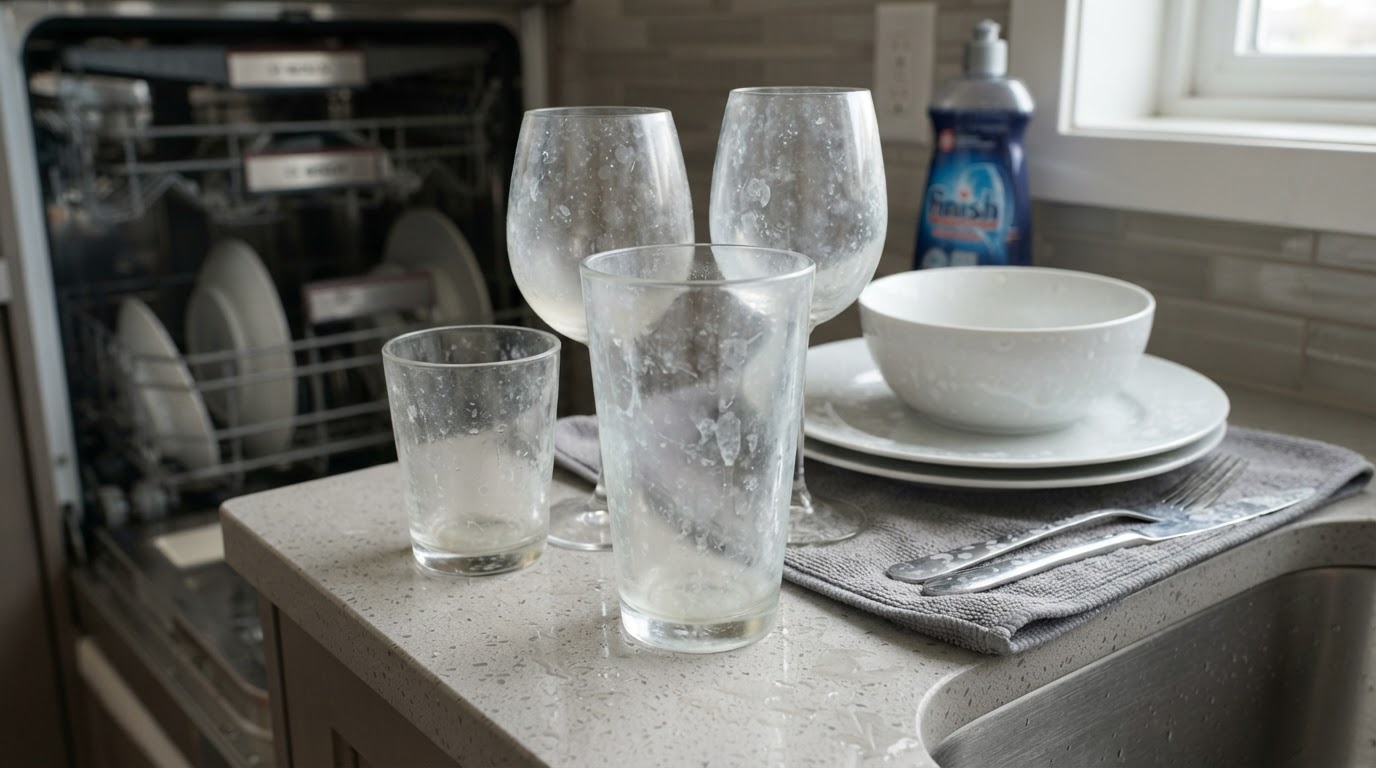
Why Are My Dishes Still Spotty After the Dishwasher?
You've loaded the dishwasher perfectly, added the premium detergent pod, filled the rinse aid dispenser, and selected the heavy-duty cycle with heated dry. Yet, when you open the door to unload, your glasses are covered in a cloudy white film, and your silverware is dotted with stubborn water spots. It's incredibly frustrating, and it might leave you wondering if your dishwasher is broken or if you're doing something wrong. The truth is, the problem likely isn't your appliance or your dishwashing routine—it's your water.
The Culprit: Hard Water Minerals
If you live in San Antonio, Boerne, or the surrounding Texas Hill Country, you are dealing with some of the hardest municipal and well water in the country. This water is packed with high concentrations of dissolved minerals, primarily calcium and magnesium, picked up from the region's limestone geology.
When your dishwasher runs, it sprays this mineral-heavy water all over your dishes. During the final drying cycle, the water evaporates into steam. However, the dissolved rock (calcium and magnesium) cannot evaporate. It is left behind, baked onto the surface of your glassware, plates, and silverware. These leftover mineral deposits are the exact cause of those annoying white spots and cloudy films.
Why Detergents and Rinse Aids Aren't Enough
You might be thinking, "But I use a high-quality detergent and a rinse aid designed to prevent spots!" While these products can help in areas with moderately hard water, they are often no match for the extreme hardness found in our local water supply.
The Detergent Problem: Hard water minerals actually react negatively with the chemical compounds in dishwashing detergent. Instead of creating a cleaning lather, the minerals bind with the soap to form a sticky, insoluble substance known as soap scum. This means a significant portion of your detergent is wasted just fighting the water hardness, leaving less cleaning power to actually remove food particles and grease from your dishes.
The Rinse Aid Limitation: Rinse aids work by breaking the surface tension of the water, allowing it to sheet off your dishes rather than forming droplets. While this helps reduce the amount of water left on the glass to evaporate, it doesn't change the chemical composition of the water itself. Any water that does remain—even a thin film—will still leave behind mineral deposits when it dries.
Spotting vs. Etching: Knowing the Difference
It's important to distinguish between temporary hard water spotting and permanent etching. Hard water spots can usually be removed by soaking the affected glassware in plain white vinegar for about 15 minutes. The mild acid in the vinegar dissolves the alkaline calcium deposits, restoring the glass's clarity.
However, if soaking in vinegar doesn't remove the cloudiness, your glasses may be etched. Etching is permanent physical damage to the glass surface. Ironically, etching is often caused by using too much harsh detergent combined with very hot water in an attempt to combat hard water spots. Over time, this combination can literally eat away at the microscopic surface of the glass, causing permanent cloudiness that cannot be washed away.
The Permanent Solution: Whole-Home Water Softening
Constantly re-washing dishes by hand, buying expensive booster additives, and soaking your glasses in vinegar is exhausting and time-consuming. The only true, permanent solution to spotty dishes is to remove the problem at its source: the hard water minerals.
A whole-home water softening system works through a process called ion exchange. Before the water ever reaches your dishwasher (or your shower, or your washing machine), it passes through a resin bed inside the softener. The resin beads attract and hold onto the calcium and magnesium ions, trading them for harmless sodium or potassium ions. The result is completely soft water flowing into your appliances.
With soft water, your dishwasher can finally perform as intended. Detergent lathers beautifully, cutting through grease without forming soap scum. Water sheets off your glasses cleanly, and when it evaporates, it leaves absolutely nothing behind. Your dishes will come out sparkling clean and crystal clear every single time, and you'll be able to use a fraction of the detergent you were using before.
Don't let hard water ruin your dishes and your dishwasher. Contact Water Softeners of San Antonio today to schedule a free in-home water analysis and discover how a custom water softening system can transform your home. You can also read about solutions for hard water or learn how much hard water really costs.